Full Stack Development in 2026: Where to Start, What to Learn and Career Opportunities
Learn how to become a Full Stack Developer in 2026, including where to learn, essential skills, common mistakes, career roles and top hiring industries in India.
WHERE TO START LEARNING FULL STACK DEVELOPMENT
If you're a fresher, the idea of learning Full Stack Development can feel overwhelming. There are so many languages, frameworks and tools that you might not know where to begin.
The good news? You don't need to learn everything at once.
The best approach is to learn step by step and start building as you learn.
Not sure what Full Stack Development actually is? Don't worry — we've covered the basics in our previous blog.
1. Start with the Basics
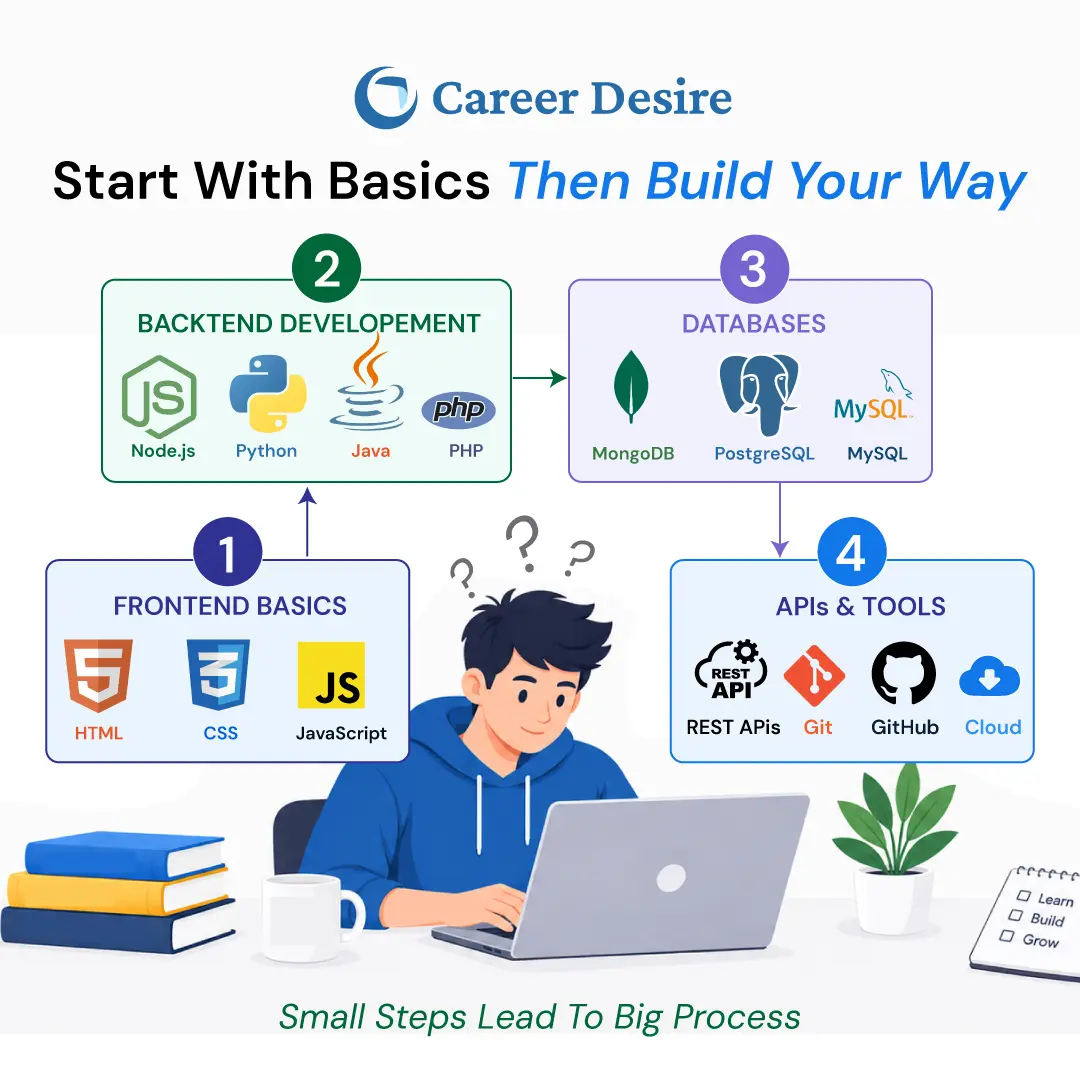
Begin with the fundamentals of web development. Learn HTML, CSS and JavaScript to understand how websites are structured, designed and made interactive.
Don't rush through these basics. A strong foundation will make it much easier to learn advanced technologies later.
2. Choose One Backend Technology
Once you're comfortable with frontend development, move to the backend.
You can choose one technology or programming language, such as Node.js, Python, Java or PHP, and focus on understanding how it works instead of trying to learn everything together.
3. Learn Databases and APIs
Next, understand how applications store and exchange information.
Learn the basics of databases and how APIs allow different parts of an application to communicate with each other. You don't need advanced knowledge at this stage — focus on understanding the concepts and using them in small projects.
4. Build Small Projects
This is where your learning starts becoming practical.
Instead of only watching tutorials, build simple projects such as a to-do app, personal portfolio, blog or basic e-commerce website.
Projects help you understand how different technologies work together and also give you something to showcase when applying for jobs.
5. Learn Git and GitHub
As you start building projects, get comfortable with Git and GitHub. They help you track your code, manage changes and showcase your projects to potential employers.
6. Keep Learning and Improving
You don't have to become a Full Stack expert before applying for your first job.
Focus on building a solid foundation, creating a few good projects and continuously improving your skills. As you work on projects, you'll naturally discover what you need to learn next.
Explore Career Desire's career coaching services to identify the right career path, understand your options, and plan your next move.WHERE CAN YOU LEARN FULL STACK DEVELOPMENT IN INDIA?
Once you know what you need to learn, the next question is obvious: Where do you actually learn Full Stack Development?
The good news is that you have plenty of options in India. You can choose an online course, join a coding bootcamp, attend a training institute or even pursue a degree with a related specialisation.
The right choice depends on your budget, learning style, available time and career goals.
Learn Through Online Courses
If you prefer learning at your own pace, online platforms can be a good place to start.
Platforms such as Coursera and Udemy offer Full Stack Development courses covering topics such as frontend development, backend development, databases and APIs.
This option can work well if you're comfortable learning independently and are willing to practise regularly.
However, simply completing a course isn't enough. You'll still need to build projects and practise what you learn.
Join a Coding Bootcamp or Job-Focused Program
If you prefer a more structured learning experience, you can consider a coding bootcamp or job-focused program.
Several platforms and training providers in India offer structured programs that include live classes, mentorship, projects and in some cases, career or placement support.
Examples include Masai School, Scaler, Coding Ninjas and GUVI.
These programs can be useful if you find it difficult to create your own learning schedule and prefer guidance from mentors.
But before joining any program, take time to check the curriculum, project opportunities, fees, reviews and the details behind any placement claims.
Choose a Degree-Based Path
If you're still planning your higher education, you can also explore degree programs related to Computer Science, Software Development or Full Stack Development.
Some universities now offer specialisations that focus on Full Stack Development as part of programs such as B.Tech, BCA, B.Sc IT or MCA.
This route takes longer, but it can provide a more structured academic foundation along with opportunities for internships, campus activities and placements.
Consider Local Training Institutes
You can also find offline or hybrid training institutes in many Indian cities.
This may be a good option if you learn better in a classroom environment and want direct interaction with trainers and other students.
However, don't choose an institute just because it promises a job at the end of the course. Look at what you'll actually learn and whether the program gives you enough opportunities to build real projects.
So, Which Option Should You Choose?
Honestly, there isn't one "best" place to learn Full Stack Development.
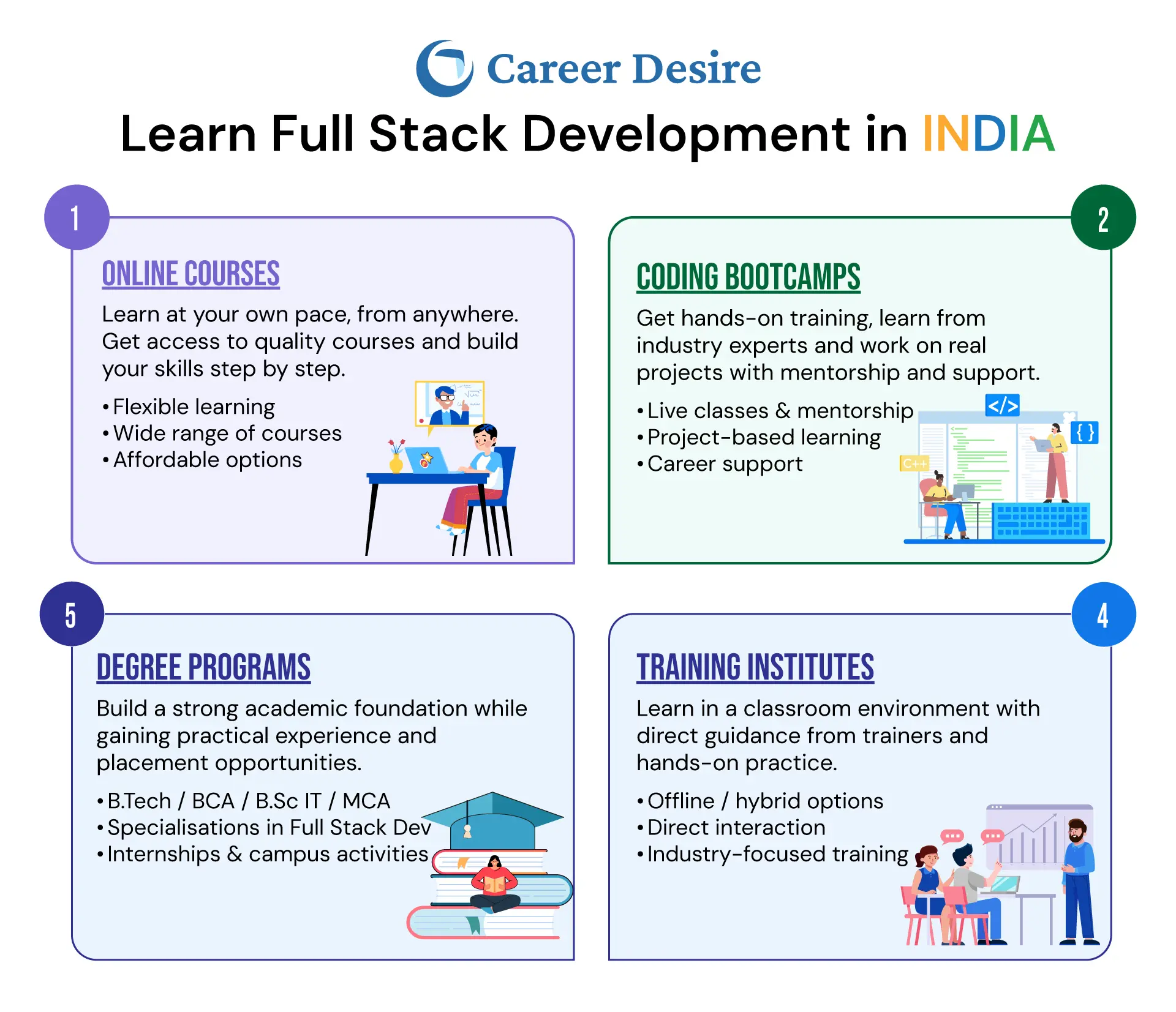
If you're self-disciplined and looking for an affordable option, online courses may work well for you.
If you need structure, mentorship and guidance, a bootcamp or job-focused program might be a better choice.
And if you're looking for a long-term academic path, a relevant degree program could make sense.
No matter where you learn, one thing remains the same: the platform alone won't make you a Full Stack Developer.
Your progress will depend on how well you understand the concepts, practise your skills and build real projects.
So instead of asking, "Which is the best course?", try asking: "Which learning method will help me learn consistently and actually build something?"
Choosing where to learn is important — but choosing a career path that matches your skills, interests and goals matters too. Explore our career services to gain clarity about your career options.COMMON MISTAKES BEGINNERS MAKE IN FULL STACK DEVELOPMENT
Learning Full Stack Development can feel overwhelming. Avoiding these common mistakes can make your journey much smoother:
1. Skipping the Basics
Jumping into advanced frameworks without understanding HTML, CSS, JavaScript and databases can create gaps in your knowledge.
2. Watching More, Building Less
Tutorials are helpful, but real learning happens when you build projects, make mistakes and solve problems yourself.
3. Focusing Only on Frontend
Full stack means understanding both frontend and backend. Don't avoid APIs, databases or server-side development.
4. Trying to Learn Everything
You don't need to master every framework or tool. Start with one stack and build a strong foundation.
5. Ignoring Git & Deployment
Git, GitHub and deployment are essential real-world skills. Start using them while building your projects.
6. Comparing Your Journey
Someone else's progress doesn't define yours. Focus on building consistently and improving one project at a time.
Avoiding these mistakes can help you become a better developer — but when you're ready to apply for jobs, you also need to present your skills and projects effectively. Explore our resume and LinkedIn optimization services to showcase your Full Stack skills, projects and potential in a way that gets noticed by recruiters.JOB ROLES YOU CAN AIM FOR AS A FULL STACK DEVELOPER
Full Stack Development can open doors to several career paths. Depending on your skills, experience and interests, you can explore roles such as:
- Full Stack Developer — Build and manage both frontend and backend of web applications.
- Frontend Developer — Focus on user interfaces and client-side development.
- Backend Developer — Work with servers, APIs, databases and application logic.
- Software Engineer — Develop, test and maintain software applications.
- DevOps Engineer — Manage deployments, cloud infrastructure and development operations.
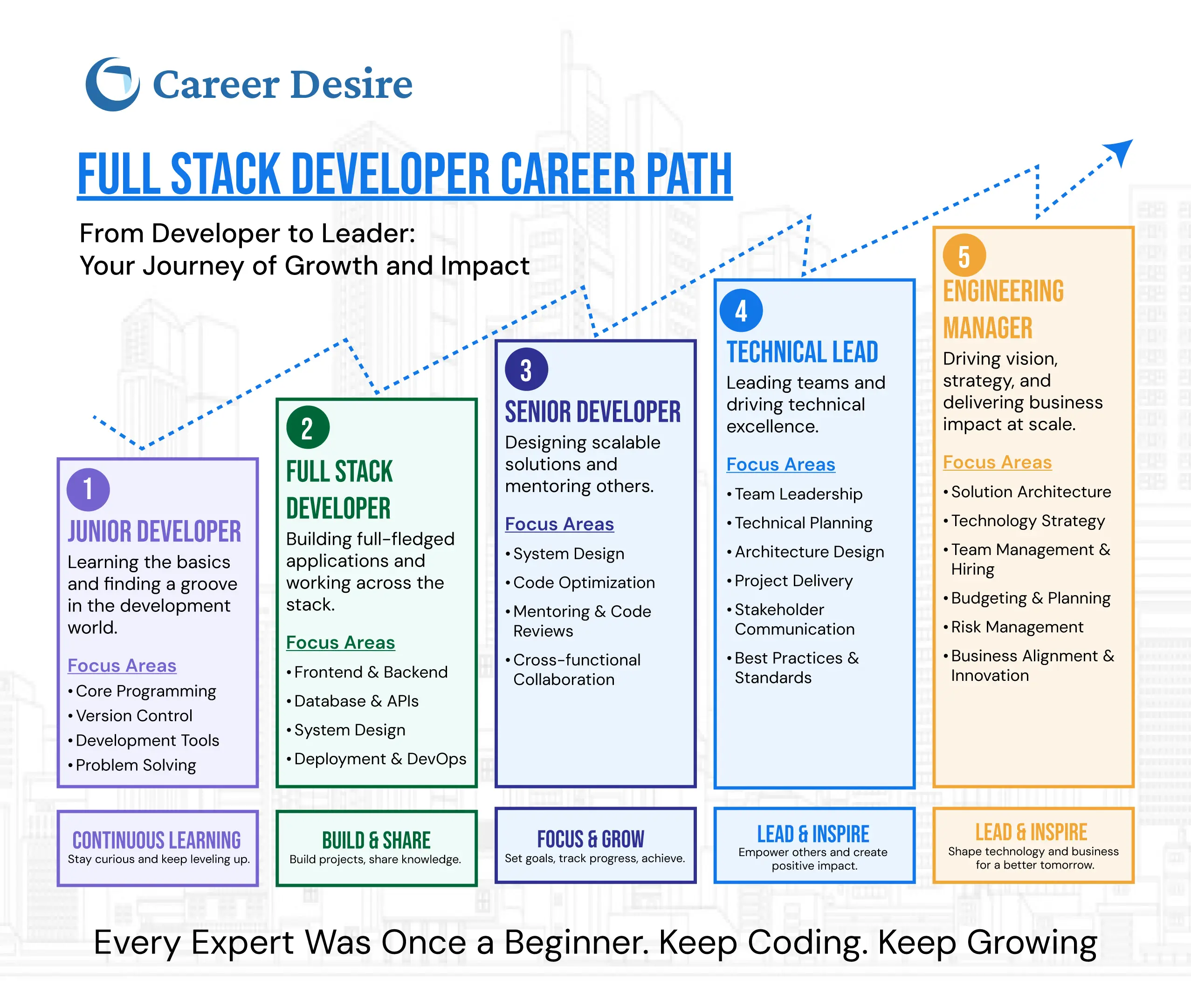
- Technical Lead — Guide developers and make key technical decisions.
- Solutions Architect — Design scalable software systems and choose suitable technologies.
- Engineering Manager — Lead development teams and manage technical projects.
With experience, you can progress from junior developer → full stack developer → senior developer → technical lead → architect or engineering manager.
Still Exploring Your Career Options?
Full Stack Development can lead to several career paths, but finding the right role for you is just as important as learning the skills.
Explore our career coaching services to identify the right career path and get guidance to land a job that fits your skills and goals.TOP INDUSTRIES HIRING FULL STACK DEVELOPERS IN 2026
Full Stack developers are in demand across industries that are building and expanding their digital products and services. In 2026, some of the key sectors hiring Full Stack developers include:
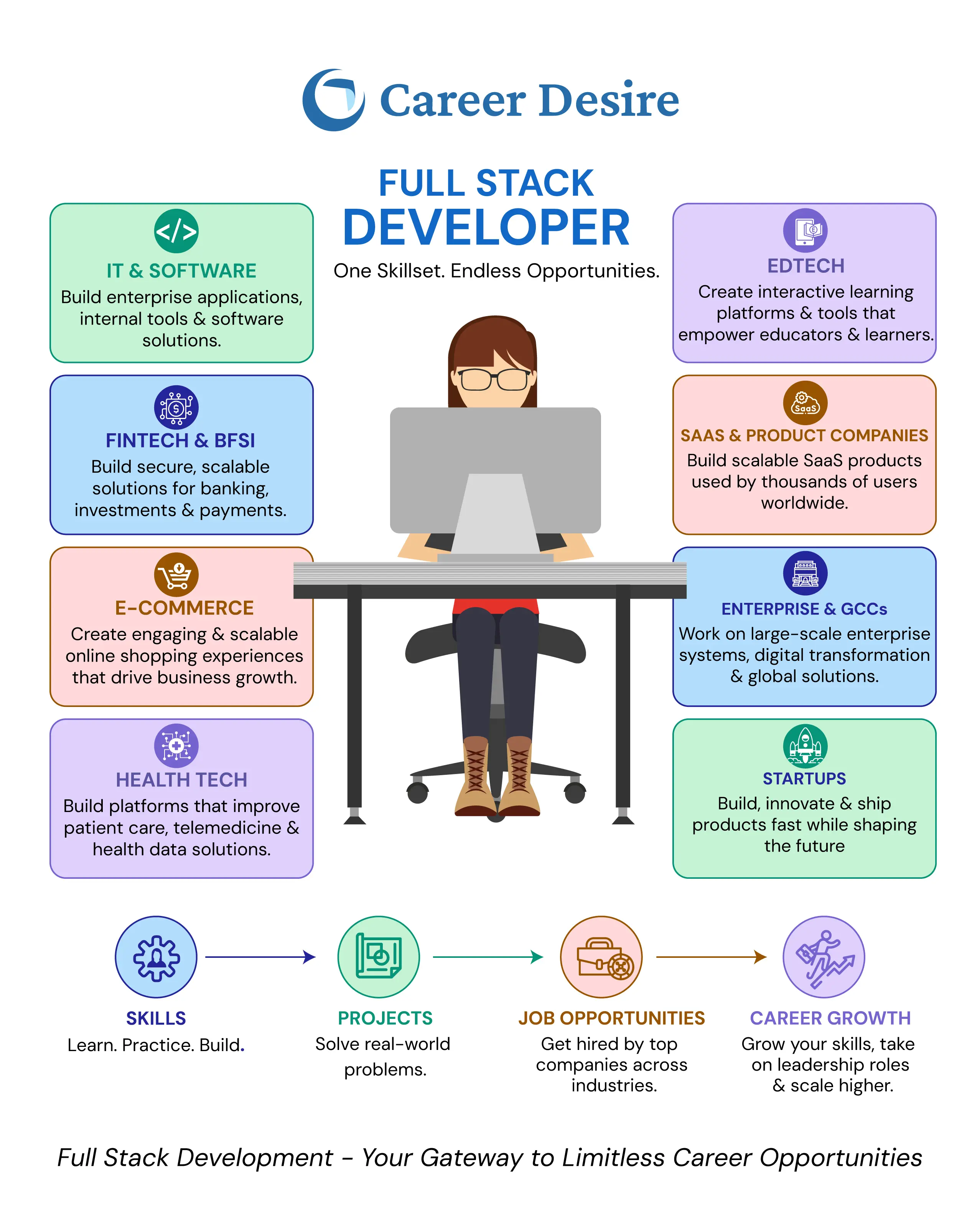
- IT Services & Consulting — Build and maintain web applications, enterprise platforms and digital solutions for clients.
- Fintech & BFSI — Develop banking platforms, payment systems, financial dashboards and secure digital services.
- SaaS & Product Companies — Build scalable web applications, dashboards, subscription platforms and business tools.
- E-commerce & Retail — Work on online stores, marketplaces, payment systems, order management and customer-facing applications.
- Healthtech — Develop healthcare platforms, appointment systems, patient portals and digital health solutions.
- Edtech — Build learning platforms, assessment systems, student dashboards and online course applications.
- Enterprise & GCCs — Work on internal tools, business applications, cloud-based platforms and large-scale digital transformation projects.
- Startups & Remote Companies — Build products from the ground up and work across frontend, backend, databases and APIs.
With digital transformation continuing across industries, Full Stack developers have opportunities to work in both technology companies and non-tech industries.
CONCLUSION
Full Stack Development gives you the flexibility to work across frontend, backend, databases and APIs, opening up multiple career paths in the tech industry.
But becoming job-ready takes more than learning programming languages. It requires practical projects, problem-solving skills and a clear career direction.
Not sure what comes after learning Full Stack Development? Don't let your skills go unnoticed. Explore the right guidance and start building a career that moves you forward.Related Articles

Jobs at Risk: Future of Work in the AI Era | Career Guide 2026
Discover which jobs are most at risk in the AI era and how to future-proof your career. Learn about automation, job trends, and high-demand skills with Career Desire's resume, LinkedIn, interview, and career guidance support.
Blockchain Developer Career Guide After 12th: Skills, Jobs, Courses, Salary & Roadmap for Beginners
So, what exactly does a blockchain developer do? Think of them as the builders of a new kind of digital system one that's secure, transparent, and really hard to mess with.
AI and Machine Learning Career Path After 12th: Complete Beginner's Guide For 2025
Okay, let's be real. Artificial Intelligence (AI) and Machine Learning (ML) sound like big scary words, right? Like something only coders in hoodies at Google HQ would understand.