GEN Z'S AI REALITY
Gen Z uses AI every day for learning, work and productivity, and the real challenge is enjoying its convenience without becoming dependent on it or losing critical thinking.
The truth is, I don't think AI is making us lazy. I think the way we choose to use AI can make us lazy.
Artificial Intelligence has quietly become part of everyday life. Whether it's helping with assignments, writing emails, generating ideas or answering questions, AI is now just a few clicks away. For Gen Z, this isn't a futuristic technology. It's a daily reality.
And that's what makes it both exciting and a little scary.
AI can help us learn faster, save time and handle repetitive tasks. It can be a useful tool that supports our learning and allows us to focus more on creativity and meaningful work.
But many young people are beginning to rely on AI for almost everything. Instead of thinking through problems, we ask AI. Instead of researching, we ask AI. Instead of struggling through challenges and learning from mistakes, we often look for the fastest answer.
The real fear isn't that AI will become smarter. It's that we may stop challenging ourselves to think, learn and grow.
While technology keeps moving forward at an incredible speed, many Gen Z people are still trying to figure out their future. New AI tools appear every month. Jobs are changing. Skills are evolving. Industries are being transformed. Sometimes, it feels like the world is moving too fast.
One of the biggest fears for many of us is not knowing where to begin. There are countless opportunities, countless skills to learn and endless advice about the future. Yet many young people are still searching for clarity about who they are and where they belong.
Feeling overwhelmed by career choices?
Explore Career GuidancePerhaps that's why discussions about AI matter so much. This is not simply a conversation about technology. It is a conversation about the future of human learning, human creativity and human potential.
As AI becomes smarter, the real challenge for Gen Z may not be learning how to use AI. It may be learning how to remain curious, creative and independent while using it.
THE WAY GEN Z USES AI TODAY
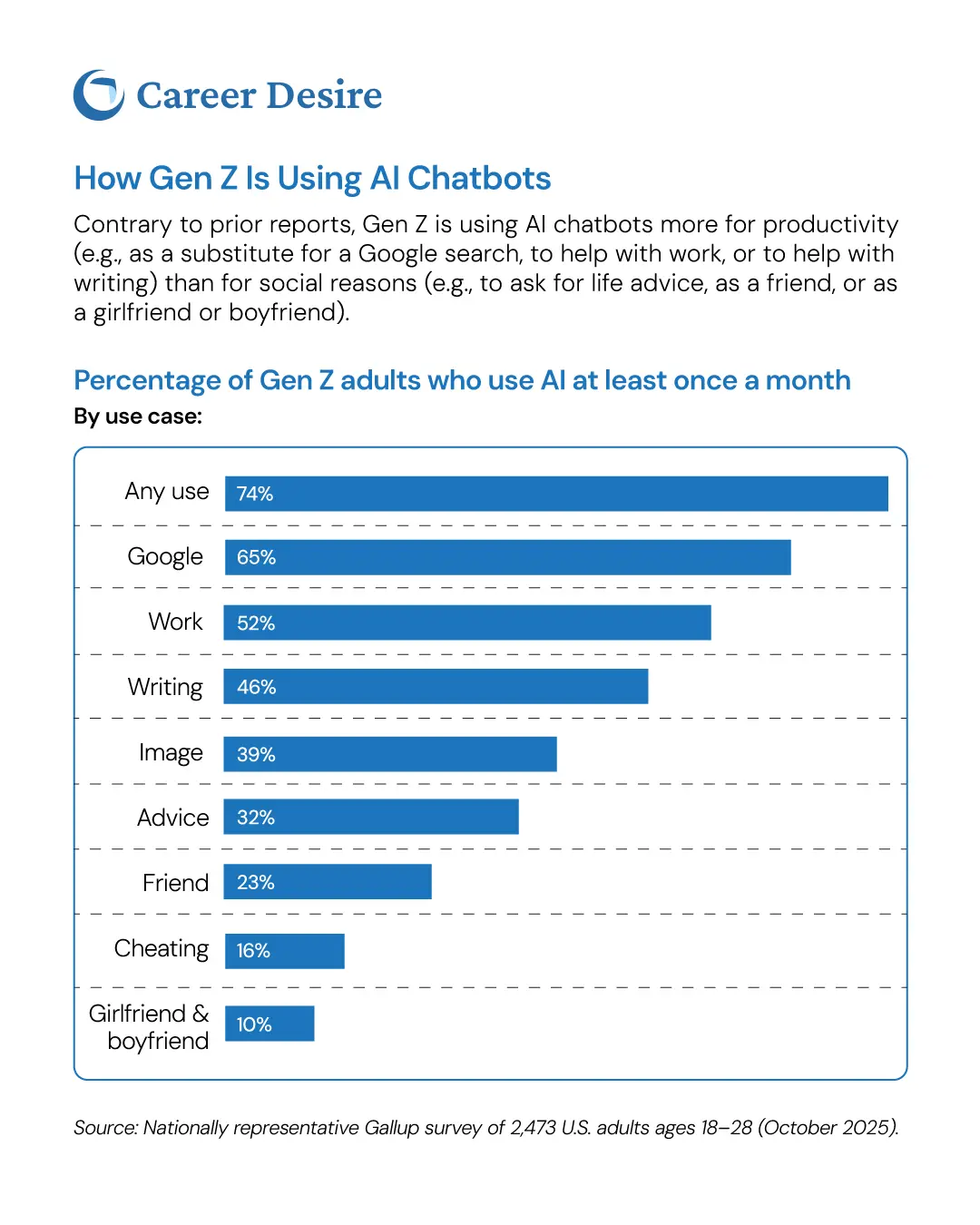
A recent survey of nearly 2,500 young adults in the United States found that most Gen Z users are turning to AI for practical purposes rather than personal companionship.
The study revealed that the most common use of AI is searching for information, with many young adults using AI as an alternative to traditional search engines. More than half of the respondents also reported using AI to help with work-related tasks, while many others used it for writing, brainstorming ideas and improving productivity.
Interestingly, the survey found that social uses of AI were far less common. While some young people use AI for life advice or emotional support, most respondents viewed AI primarily as a tool for learning, working and completing tasks more efficiently.
These findings challenge the popular belief that Gen Z mainly uses AI as a friend or virtual companion. Instead, the data suggest that young people see AI as a practical assistant that helps them save time and get things done.
However, the survey also revealed something equally important: even though Gen Z uses AI extensively, many of them are worried about the long-term impact it may have on learning, critical thinking and personal growth.
GEN Z'S MIXED FEELINGS ABOUT AI
While AI offers convenience and efficiency, many young people have mixed feelings about its growing role in daily life.
A recent survey found that many Gen Z users worry that relying too much on AI could make people lazier and less likely to think for themselves. Many are concerned that constantly turning to AI for answers may reduce opportunities to learn through experience and solve problems.
One major concern is that AI makes it easy to skip the learning process. Instead of struggling with a problem, researching solutions or learning from mistakes, people can receive instant answers within seconds. While this saves time, it may also reduce the effort that builds knowledge and confidence.
There are also concerns about creativity and human interaction. If AI becomes the first place we turn to for ideas, advice and guidance, are we giving ourselves enough space to think independently and learn from others?
What makes this discussion interesting is that these concerns often come from the same generation that uses AI the most. Gen Z appreciates the benefits of AI, but many also recognise the risks of becoming too dependent on it.
THINK FIRST, AI SECOND
If you find yourself relying on AI for almost everything, you're not alone. Many young people are growing up in a world where answers are available instantly. It is natural to use tools that make life easier.
But the solution is not to stop using AI. The solution is to stop making AI your first response to every problem.
When a challenge comes up, pause for a moment before opening ChatGPT or any other AI tool. Ask yourself:
- What is the actual problem?
- What do I already know about it?
- What information am I missing?
- What are some possible solutions?
Write down your thoughts, even if they seem incomplete. This simple habit trains your brain to analyse situations instead of immediately searching for answers.
For example, if you're confused about your career path, don't ask AI to decide your future. Start by understanding yourself. Think about your interests, strengths, values and the kind of life you want to build. Then use AI to organise your ideas, explore opportunities and learn new skills.
Still feeling lost or unsure where to start?
Get Career Coaching
The same applies to learning. Try to understand a concept on your own first. Read, take notes, make mistakes and attempt solutions. If you get stuck, let AI guide you — not replace your effort.
Many young people worry that AI will affect their future. The truth is that technology will continue to change, whether we are ready or not. But you don't need to learn every tool or master every trend overnight.
Take your time. Learn one skill at a time. Stay curious. Use AI to support your growth.
KEEPING WHAT MAKES US HUMAN
AI should make our work easier, not make our thinking unnecessary.
As someone from Gen Z, what worries me is how easily we can become dependent on it without realising. The ability to think critically, solve problems and learn through experience is what helps us grow. Those skills should never be handed over completely to a machine.

Sometimes it feels like the world is moving too fast. New technologies appear every day, and the pressure to keep up can be overwhelming. There are moments when it feels like everyone else has figured out the future while you're still trying to decide where to begin.
But maybe the answer isn't to move faster. Maybe it's to slow down, focus on learning, build skills one step at a time and use AI as a tool rather than a shortcut.
You do not need to know everything today. You do not need to master every new technology tomorrow.
Perhaps the real challenge isn't learning how to use AI. It's making sure we don't lose our curiosity, creativity and ability to think independently while using it.
Focus on skills that align with your career goals
Explore Career Services